I was invited by a personal friend to attend a seminar preview for an upcoming training event on business leadership and corporate management. Normal attendees have to pay $20 for the preview.
Halfway through the preview, a man from the audience stood up and said, "This is not what I've expected. It is printed on your ad, 'How to profit from the coming recession' and you're telling me all this about how to be a successful manager and leadership skills. I'm only an employee working for a company..." He said something like that along this line.
The presenter replied, "That's right. It is only by developing yourself and improving your personal performance in your environment that you can begin to charge a higher premium for your wages..."...along this line of argument.
But the exchange got more unpleasant and the man got angrier. Soon after, the man and a few others were shouting for a refund and more would walk out because of the negative energy prevailing in the room.
It was so bad, I haven't seen a seminar conducted with such devastating result. Even I get angry myself thinking over it.
Upon mutual feedback with the friend, these are what I discover:
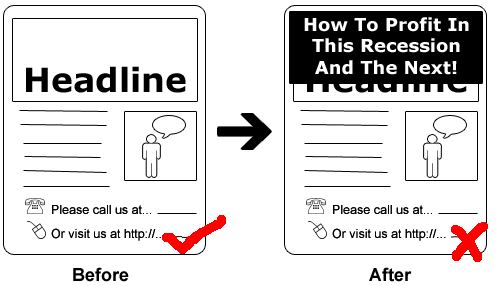
1) The 'recession' headline: No doubt you have seen such headlines all over the place, in e-mails, newspapers etc. for all kinds of programs. I can tell you it is unoriginal, it sucks, too overused and gives a "jump on bandwagon" impression. Seth Godin is right: All marketers are liars.
2) The impact of the headline: Ted Nicholas quoted the late, great and iconic copywriter John Caples as having said, "73% of all buying decisions are made at the point of the headline." That also means there is 73% probability you're going to attract a certain type of crowd depending on what the headline says. Do you know what profile of your crowd is?
3) The crowd: The bigger the crowd you're trying to attract, the more 'hazy' its profile is, because at the end you're not going to fulfill every, Tom, Dick and Harry's needs for sure. Every prospect has certain inarticulate expectations on how to pull through the recession; they just need to find the best answers they can resonate with. The 'problem' with recession concerns is they usually start at a base level, like "how to save money". I've seen for myself the presenter had a tough time selling a high-concept solution to match anyone's base-level expectations.
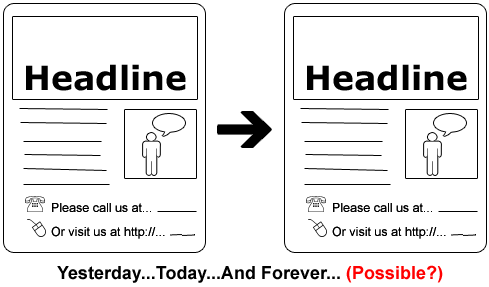
I only have one suggestion for remedy and it's "If it ain't broke, don't fix it". The previous ad was quite okay and if it did well, the copywriter should not lump it with irrelevant correlations. Just focus on explaining the details of the program or product, promoting the benefits of attending the program or buying a product, and print out testimonials based on user experience of the program/product.
One good ad solution for a ‘live’ program that may sell better than the slickest copy ever written is to create a download link to a PDF file which outlines the full timetable/program synopsis, including lunch break and tea break times, so the prospects know “what you see is what you get”.
Have you seen or heard of classic case studies where an ad can run for years with hardly a change or an edit and still covert sales like hot cakes? These ads are sharp enough to articulate the inarticulate and pre-empt the questions inside the prospects’ heads, e.g.:
* Have you ever wondered how to resolve the inter-departmental frictions and rivalries within your company?
* Do you want to know your colleagues more like a friend, and understand their strengths and weaknesses so you can get them to perform optimally in future business projects and ultimately make your office an ADDICTIVE place to work AND play in?
Tweaks are necessary to make the ad read like it appeals to the taste of the current generation of the crowd, but should not be radical enough to change the essence of the message, especially the headline.
The friend had said, “The reason we changed our ad is to make it look fresh to attract a different crowd. We don’t want the public to know it’s the same thing again.”
That’s a wrong perspective. It is ALWAYS a different crowd if an old ad can still convert profitably, because different people resonate with various ad proposals at different times. An ad may not catch their eyes in May 2008, but you never know they really need to learn more about it in January 2009.
Put it this way: you don’t need skimpily-clad girls to dance around a Lamborghini to sell it. The Lamborghini has been around since 1963 and it has already spoken for itself. Fans of Lamborghini will claw their way for it sooner or later. It is still flashy, exclusive and turbo yesterday, today and forever, but don’t start thumping down Ferrari and get into all kinds of avoidable trouble.
The same principle applies to your AdWords campaign. Say if you’re selling antique ladies’ watches and there’s a particular model that looks good on most grandmothers’ wrists, your ad would read along the lines of “The perfect watch gift for your grandmother” all the way to your sales page where it says aloud, “The perfect watch gift for your grandmother”, word for word. It may sound dumb and simple, but not misleading prospects one bit in every way possible could be the best strategy for cutting PPC losses and increasing profits.
Stay consistent and congruent to your marketing message and people will take you for who you are. Perhaps that’s the essence of leadership after all.
1 | 2


 Posts
Posts


No comments:
Post a Comment